

Short answer
Use AI to speed up the work around market research, not to manufacture the market. Define the decision and customer segment first; collect interviews, public prices, regulator documents, competitor pages and customer questions; use AI to cluster notes, compare claims, expose gaps and draft hypotheses; then verify every material statement against its original source. An AI competitor list is a discovery aid, not a market census.
A founder in Kampala asks an AI assistant: “Who are my competitors and what do customers want?” The answer comes back quickly. It may also be wrong in several quiet ways.
A name may belong to the wrong country. A price may be out of date. Three interview comments may be presented as a regional trend. A plausible competitor may not serve your customer at all.
AI can make early market research faster. It cannot turn a guess into evidence. My rule is: question first, sources second, pattern last.
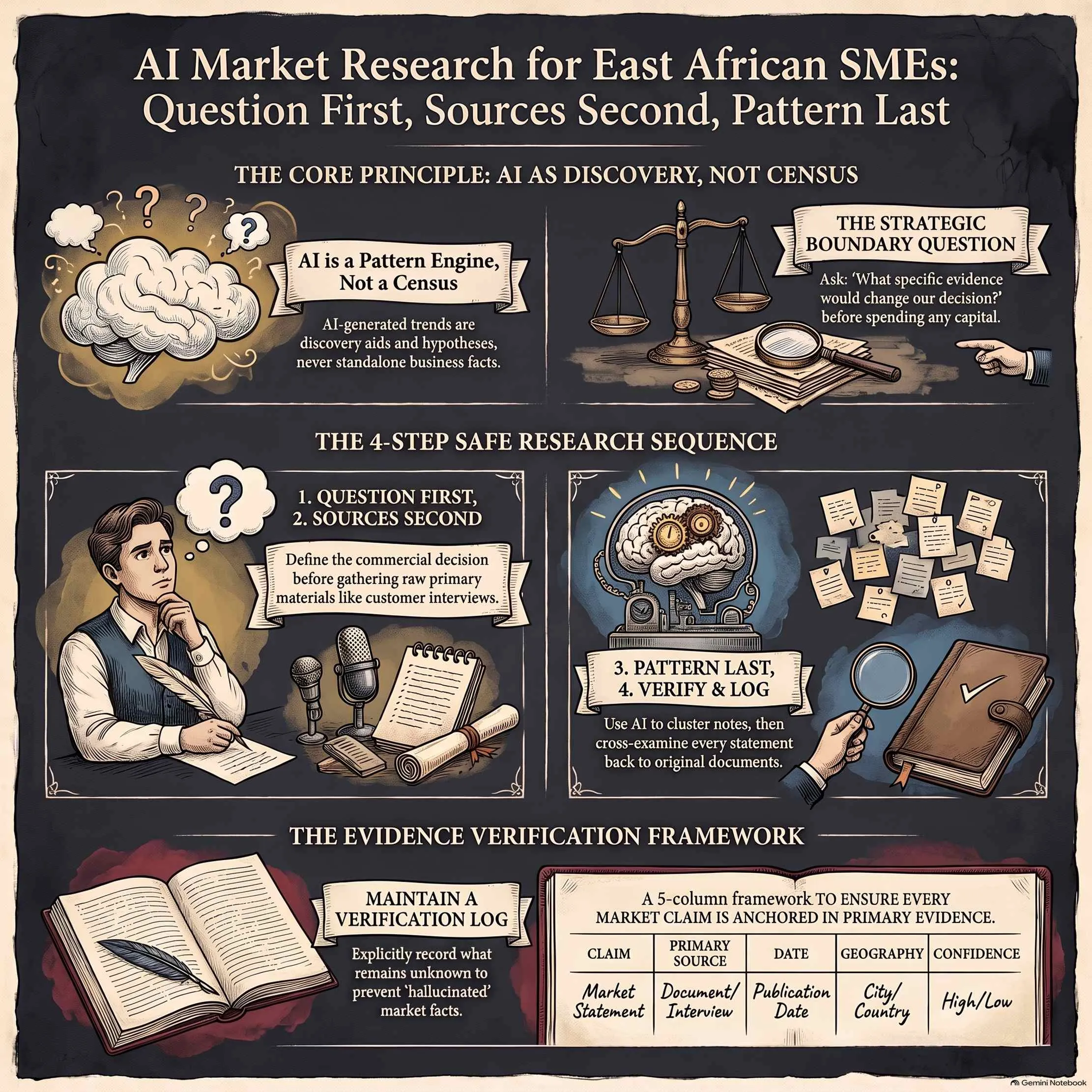
The question comes before the prompt
“Who are my competitors?” is a useful opening question, but it is not yet a research decision. Start with the choice that must be made:
- Should we launch this service in a named city or country?
- Which customer segment should we serve first?
- Is the buying problem strong enough to justify a new offer?
- Which price range, channel or feature deserves a small test?
- What evidence would make us delay, narrow or abandon the idea?
Then name the segment narrowly. “SMEs in East Africa” is a starting label, not a research population. A five-person repair workshop in Kampala, a growing distributor in Kigali and a professional-services firm selling across the Great Lakes region may have different buyers, budgets, regulations, languages and routes to purchase.
Write the decision in one sentence:
We are deciding whether [offer] should be tested with [specific customer group] in [defined geography] through [proposed channel], and we will change the decision if [evidence or threshold] appears.
The last part protects the research from becoming a presentation of reasons to proceed. Ask it before the evidence confirms what you hope is true.
A four-part workflow
1. Define the decision and segment
Create a one-page research brief before opening an AI chat. Record the decision, geography, customer segment, time period, competitors or alternatives to examine and what is out of scope.
Add the customer’s job, not only a demographic label. What are they trying to get done? What do they use now? What does delay, failure or switching cost them? What words do they use when they describe the problem?
A competitor is not every organisation with a similar name. It may be a direct provider, an informal substitute, an internal process, a WhatsApp group, a trusted intermediary or the customer’s decision to do nothing.
2. Gather primary material
Collect source material before asking AI for patterns. For an early SME study, this may include:
- short interviews with prospective customers and channel partners;
- customer enquiries, objections and support questions, with personal information removed;
- competitor websites, product pages, public price lists and published terms;
- regulator notices, licences, tender documents or official market information;
- distributor, supplier and association materials;
- public reviews and comments, treated as individual signals rather than a representative survey; and
- your own sales, enquiry, delivery or pilot records where you have permission to use them.
Record the source URL or file, publication or access date, geography, speaker or publisher and the exact claim you are taking from it. Keep the original page, screenshot or document where the material could change.
Primary does not mean automatically true. A competitor’s pricing page describes that competitor’s published offer. It does not prove every customer pays that price, that the page is current or that the service is available in every city. An interview gives you one person’s account and language. It does not establish the size of the whole market.

3. Use AI to organise and challenge the material
Give an AI assistant a bounded collection of notes and sources and ask it to perform tasks that remain inspectable:
- group customer statements by problem, trigger, objection or desired outcome;
- identify duplicate claims and terms that appear to mean different things;
- compare competitor offers using the same fields;
- list missing evidence and questions that deserve another interview;
- separate direct observations from interpretations and proposed hypotheses;
- find contradictions between sources; and
- draft a research table or interview guide for human review.
Ask for source IDs beside each grouped statement. If the tool cannot point back to the note, page or document behind a claim, treat the statement as an unverified suggestion.
The AI is acting as a fast organiser and critic. It is not becoming a field researcher. It cannot know whether an interviewee exaggerated, whether a price page is stale, whether two businesses serve the same segment or whether a quiet customer group is absent from your sample rather than absent from the market.
4. Verify material statements
Return to the original source for every statement that could change the decision. Check the wording, date, geography, customer segment and strength of the evidence.
Ask five questions:
- Does the source actually say this, or has the AI widened the claim?
- Is the source about the geography and customer group we are deciding about?
- Is it current enough for this decision?
- Is it a direct observation, a reported opinion, a calculation or an inference?
- What remains unknown even after reading the source?
Mark the result as verified, partially supported, contradicted or unknown. Do not quietly upgrade “three interviewees mentioned delivery delays” into “customers in Kigali want faster delivery”. The second statement may become a hypothesis for more research; it is not the same evidence.

Why an AI competitor list is not a market census
An AI-generated list can help you discover search terms, categories, brands, substitutes and follow-up questions. It can also omit small providers, informal operators, new entrants, local-language pages and businesses with weak online visibility.
It may mix countries, confuse a product with its parent company, repeat the same organisation under different names or include a provider that no longer operates. None of this makes the list useless. It defines its correct role.
Use the list to build a search-and-verification queue. For every candidate, confirm the name, location, offer, customer group, price or pricing method, channel, source date and current status from an original page or another traceable source. Add “not verified” when the evidence is missing. A blank cell is a research result.
The same rule applies to patterns. If the tool says customers prefer monthly pricing, ask: which customers, in which geography, based on how many statements, during what period and compared with what alternative? A pattern should make the next check clearer, not make uncertainty disappear.
The evidence worksheet
Use one row for each material claim or observation. Keep “source” separate from “confidence”; a source can be official but irrelevant to your segment, while an interview can be directly relevant but narrow.
| Claim or observation | Source | Date | Geography | Confidence | Next check |
|---|---|---|---|---|---|
| URL, document or interview ID | published/accessed | country, city or region | high / medium / low | person, source or test | |
Add customer segment and evidence type when the decision matters. Evidence type might be interview, public document, competitor claim, observed behaviour, calculation or AI-generated hypothesis.
Do not let confidence become a feeling. Write why the rating exists. “High” might mean the statement is explicit in a current regulator document for the target country. “Medium” might mean several relevant interviews agree but the sample is small. “Low” might mean the only support is an AI summary or one undated page.
What evidence would change the decision?
Ask this before the research confirms what you hope is true.
If you would launch only when ten target customers agree to a paid pilot, write that down. If a regulator document, a competitor price change, a repeated objection, a failed delivery test or a lower-than-expected willingness to pay would make you narrow the offer, record that too.
This question protects the research from becoming a presentation of reasons to proceed. Ask the AI to find evidence that would disconfirm the working hypothesis, not only material that supports it.
The answer may be “we do not yet know”. That is a valid result. The next step could be five more interviews, a price test, a visit to the channel, a review of official requirements or a small paid pilot. It should not be a larger marketing budget simply because the AI produced a confident summary.
A practical division of labour
- You define: the decision, segment, geography, risk and stop rule.
- People collect: interviews, observations, local context and permissioned records.
- AI helps organise: themes, contradictions, gaps, comparisons and draft hypotheses.
- A named reviewer verifies: material claims against original sources.
- The decision owner chooses: launch, narrow, test again, wait or stop.
AI can reduce the time spent sorting notes. It cannot give you local customer access, consent, judgement or accountability. Those are the parts that make market research useful.
Before you act
Your research is ready for a decision when the important claims have a source, the source has a date and geography, the customer segment is explicit, hypotheses are labelled, gaps are visible and somebody has answered what would change the decision.
If the table is full of uncited summaries, mixed countries, undated competitor pages and patterns no interview or document supports, you do not have a market fact base yet. You have a list of research leads. That is still useful—if you label it honestly and do the next check.
Question first. Sources second. Pattern last. That order keeps AI fast without allowing it to turn a plausible answer into a business fact.
Frequently asked questions
Can AI conduct market research on its own?
No. AI can help organise notes, compare claims, find gaps and draft hypotheses, but people still need to define the decision, collect relevant local material and verify important statements against original sources.
Can I trust an AI-generated list of competitors?
Use it as a discovery list, not a market census. Confirm each candidate’s identity, location, offer, customer segment, price or pricing method, source date and current status from an original or traceable source.
What is the most important market-research prompt?
The most important question comes before the prompt: what decision are you trying to make, for which customer segment and geography, and what evidence would change the decision? Once that is clear, ask AI to perform a bounded, reviewable task.
How should we record AI-assisted market research?
Keep a worksheet with the claim or observation, source, date, geography, confidence and next check. Add the customer segment and evidence type when the decision matters. Preserve the original source and label AI-generated hypotheses clearly.
Sources & the researchers worth crediting
This article draws on Stephanie Diamond’s Claude For Dummies, chapters 11, 13, 15, 17 and 18, for research framing, handling information and documents, workflow support, current-information checks and verification discipline. It also draws on Thomas Heinrich Musiolik, Jose Esteves, Hemachandran Kannan and Raul Villamarin Rodriguez (eds.), Decoding Global Marketing Decisions: Leveraging AI and Emotional Intelligence for Entrepreneurial Success, especially the chapters on consumer mind across borders, global marketing, AI-powered decision support and pattern recognition in historical data. These books provide durable methods, not current market facts about Kampala, Kigali or any other specific market.
Read next
Before You Buy AI, Clean Your Business Data
Check whether the records underneath an AI workflow are consistent enough to trust.
Use AI to strengthen a fundable business plan
Stress-test assumptions while keeping every number tied to a defensible input.
Responsible AI without digital dependence
Set practical boundaries around data, contracts, capability and accountability.
About the author
Peter Bamuhigire
Software architect and ICT consultant — business systems and evidence-led decisions across Africa
Peter Bamuhigire helps owners and managers turn technology and market information into workable decisions. His approach keeps AI-assisted research connected to source records, local context, human review and the business choice the evidence must inform.