

Short answer
Choose a project consultant when the outcome is bounded. Choose fractional technology leadership when important technology decisions recur but the workload is not yet a full-time executive job. Choose a permanent CTO when technology needs daily leadership, continuous team management and sustained accountability inside the business. Review the choice every quarter as the decision load changes.
A growing business can reach an awkward middle. The spreadsheets, cloud accounts, vendors, integrations and security decisions have outgrown ad-hoc IT, but the business does not yet have a full-time executive job for a CTO.
The usual responses are familiar: keep asking whoever is available, or hire a senior person before the work justifies the cost. Both choices create risk. There is a third option: bring in senior technology leadership for a defined fraction of the week, with clear decisions to own and a review point.
But the title is not the decision. The workload is.
Start with the decision load, not the job title
Write down the technology decisions your leadership team expects to face in the next quarter. Include the decisions sitting in email threads, vendor meetings and the founder’s head:
- which system should own customer, stock, finance or operational data;
- what to build, buy, integrate or stop;
- which vendor is accountable for a delayed or fragile delivery;
- what security, backup, access and privacy controls are proportionate to the business;
- which technical roles to hire and how to assess the candidates; and
- what must be true before the next branch, product launch or market expansion.
If there is one bounded problem, commission a project. If the list is full of recurring, high-consequence decisions but no one has the senior judgement to make them, consider fractional leadership. If those decisions now require daily attention, permanent leadership is probably the honest answer.
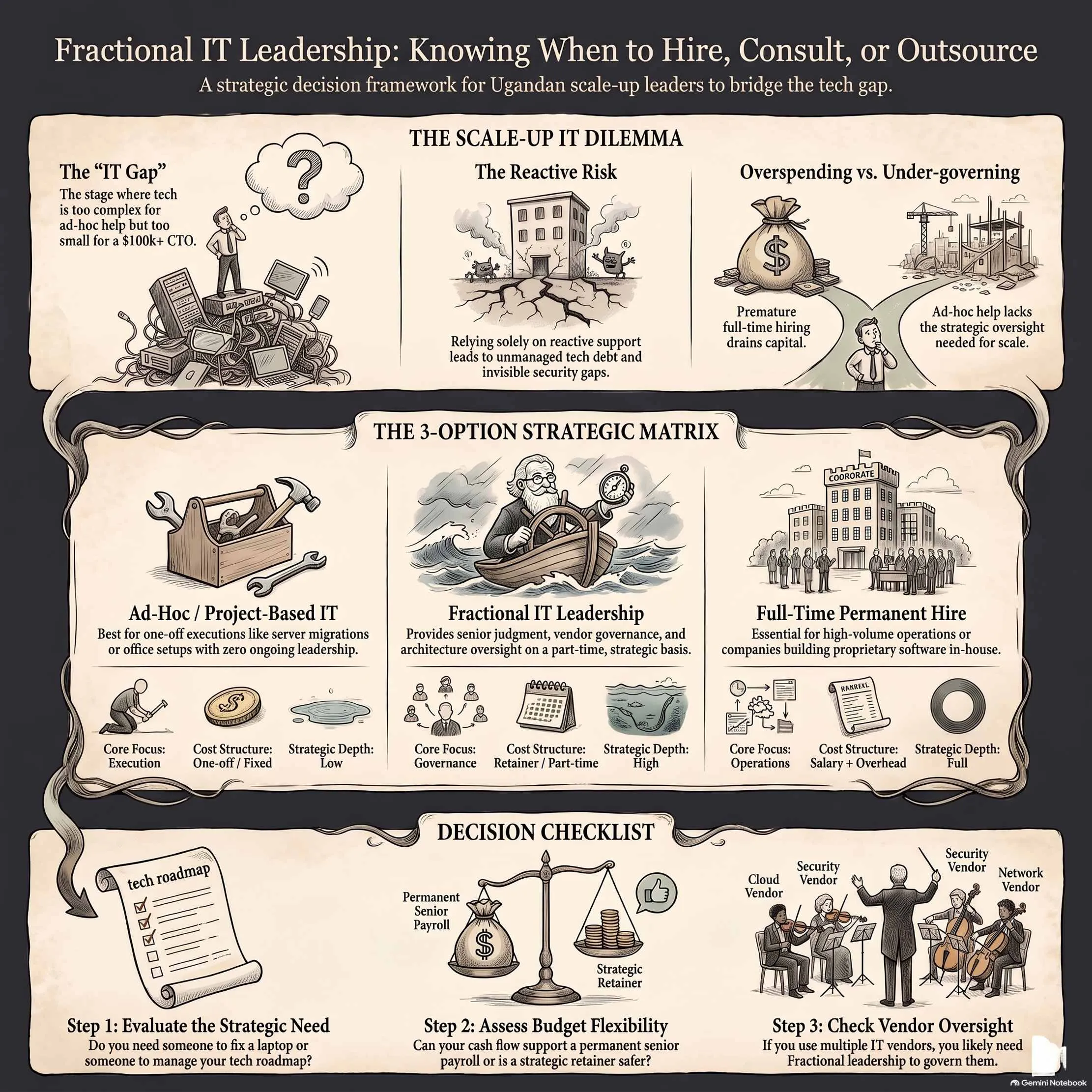
Three options, three different jobs
| Option | Best fit | What success looks like |
|---|---|---|
| Project consultant | A defined outcome with a start and finish | A working deliverable, documented handover and agreed support window |
| Fractional CTO | Recurring strategic decisions without a full-time workload | Clear priorities, accountable vendors, recorded decisions and a stronger internal operating rhythm |
| Full-time CTO | Daily technology leadership, team management and continuous immersion | A permanent technology function with people, standards, execution and business accountability |
1. A project consultant fixes a defined problem
Use a project consultant when you can describe the outcome without describing a new executive role. Examples include moving email to a controlled tenant, implementing an ERP, repairing a network, reviewing an application, building a website or delivering a reporting integration.
The contract should state the result, the boundaries, the client-side owner, the information the consultant needs, the acceptance test, the change process and what happens after handover. A project can include expert advice. It does not create ongoing ownership by itself.
If your problem is “the new system must go live by a certain date”, start with a project. If the problem is “we have made six important technology decisions this year and nobody can explain why”, you are looking at a leadership gap.
2. A fractional CTO owns recurring judgement
A fractional CTO works part-time, but the work is not part-time in importance. The role can own the technology roadmap, architecture choices, build-versus-buy decisions, vendor oversight, risk framing and the cadence at which leadership reviews progress.
That is different from hiring another person to close tickets. The fractional leader may bring in a developer, network specialist, security assessor or software vendor, but they keep the decision chain visible. Who recommended this system? What business problem does it solve? What will it cost to operate? Who owns the data? What happens when the vendor misses the milestone?

Set the boundaries early. A fractional CTO is not unlimited helpdesk coverage, an on-call promise that nobody documented, or a substitute for a permanent operations manager. The engagement needs a sponsor, an agreed number of hours or days, access to the right information, a decision log and a review date.
3. A full-time CTO carries daily organisational responsibility
Hire full-time when technology leadership is a sustained job, not a monthly meeting. The role may need to lead several engineering or product teams, recruit and coach managers, shape technical culture, handle frequent production trade-offs, work through customer escalations, and represent the technology function to the board or investors.
Daily presence matters here. Culture is built in code reviews, planning meetings, incident decisions and the small conversations that determine whether a team raises a risk early or hides it. A fractional leader can influence those habits. A permanent leader can live inside them.
Do not hire full-time because the title sounds credible in a pitch deck. Hire when there is enough continuous responsibility for the person to spend most of the week making the business better through technology and the team around it.
A five-question decision test
Answer these questions without using company age or funding stage as a shortcut.
- Is the need bounded? If you can define the outcome, owner and acceptance test, begin with a project.
- Do important decisions keep returning? Repeated architecture, vendor, security, hiring or prioritisation decisions point towards fractional leadership.
- Does technology need daily leadership? If several teams, live systems or customers require continuous judgement and people management, test the case for a full-time role.
- What risk are you carrying? NIST’s small-enterprise guidance treats information security and privacy as business risks. If nobody owns access, backups, data handling and recovery decisions, the gap is larger than a technical inconvenience.
- Can the business give the role authority? Senior advice without access to decision-makers, vendors, budgets and system information becomes an expensive opinion. Fix the sponsorship problem before you buy the title.
The answer may be different for different parts of the business. You might use a project consultant for an ERP implementation, a fractional CTO to govern the roadmap and a managed service provider to keep devices and networks running. The options can work together when their responsibilities are written down.
What a good 90-day fractional engagement should leave behind
Do not buy a retainer whose only deliverable is attendance. In the first 90 days, a useful fractional engagement should leave the business with evidence it can use:
- a current-state map of systems, data, vendors, owners and important dependencies;
- a short decision register showing what was decided, why, who owns it and what was rejected;
- a prioritised technology roadmap tied to business outcomes, budget and capacity;
- a vendor and contract review that makes missing ownership and weak deliverables visible;
- a proportionate baseline for identity, backups, access, privacy and incident recovery;
- a hiring or capability plan if the business needs internal technical ownership; and
- a review point with clear signals for continuing, reducing, changing or converting the engagement.
Uganda’s Digital Transformation Roadmap groups its national priorities around infrastructure and connectivity, digital services, cybersecurity and data protection, digital skills, and innovation. A small business does not need to reproduce a national programme. It does need to ask whether its own technology decisions have owners across those same practical areas.
When fractional is the wrong answer
Fractional leadership is not a cheaper version of every technology role. Choose something else when:
- the architecture is stable and the real bottleneck is more delivery capacity;
- the work is a single implementation with a clear acceptance test;
- the business needs a person available every day to lead a large or growing team;
- the system has uptime, safety or customer obligations that require continuous in-house authority; or
- the sponsor wants a title but will not give the person access, budget or a decision mandate.
There is also a common failure on the other side: calling a full-time job “fractional” because the budget is uncomfortable. If the person is expected to attend every meeting, manage every incident, supervise every developer and answer at all hours, the business is asking for a permanent role while paying for a part-time arrangement. That will fail the person and the company.

Make the choice reviewable
Set a review date before the engagement starts. At that point, ask what changed: are decisions clearer, are vendors more accountable, is the roadmap being followed, and has the work become a daily leadership job?
If yes, hire permanently or define why the fractional model still fits. If no, change the scope or stop. The point of fractional leadership is not to create dependency. It is to put senior judgement where the business needs it, then make the next decision with better information.
The useful question for your business today is not “Can we afford a CTO?” It is “What technology decisions are we making, how often do they return, what happens if we get them wrong, and who has the authority to make them?”
If you can answer those four questions, the right option usually becomes much easier to see. If you cannot, that uncertainty is itself the first technology decision to address.
Frequently asked questions
What is a fractional CTO?
A fractional CTO is a senior technology leader who works with a business part-time or for a defined period. They help set direction, make architecture and build-versus-buy decisions, oversee vendors, frame risk, and establish a decision rhythm without becoming a permanent full-time employee.
Is a fractional CTO the same as an IT consultant?
No. A project consultant is usually engaged for a defined outcome, such as a migration, system implementation, audit or software build. A fractional CTO stays involved across recurring leadership decisions and owns the quality of the technology direction, while specialist consultants or vendors may execute the work.
When should a business hire a full-time CTO?
Hire a full-time technology leader when the role has a daily, sustained workload: leading several teams, shaping engineering culture, handling frequent production decisions, building a permanent technology function, and representing technology continuously to customers, investors or the board.
Can a fractional CTO help a business prepare for a full-time hire?
Yes. A well-scoped engagement can produce the role definition, technology roadmap, architecture record, hiring scorecard, vendor map and first-quarter priorities that make a permanent hire more precise. Agree the review point and the handover expectation at the start.
What if we only need someone to fix our systems?
Start with a project or diagnostic if the problem is bounded. A broken backup, network, website, accounting integration or application may need a capable specialist and a clear statement of work, not a CTO title. Add leadership only if the diagnostic reveals recurring decisions that no one owns.
Sources & the researchers worth crediting
The distinction between fractional leadership and a project engagement is an operating framework, not a promise that one model fits every business. Harvard Business Review provides context on fractional senior leadership; NIST provides small-business guidance on risk and contracting; Uganda’s Ministry of ICT and National Guidance provides the local digital-transformation context. The decision criteria and examples below are Peter Bamuhigire’s analysis.
Read next
How to choose an IT consultant in East Africa
Questions to ask, red flags to watch for, and what a good consulting engagement leaves behind.
How to run a software project so it finishes
Scope, milestones, change control and client-side ownership for a project with a real finish line.
ICT consulting and technology strategy in East Africa
A practical conversation about systems, vendors, delivery risk and the next technology decision.
About the author
Peter Bamuhigire
Software architect and ICT consultant
Peter Bamuhigire works with organisations where business growth, software, infrastructure, vendors and operational risk meet. He writes for leaders who need technology decisions they can explain, fund and own.